
Business Central Expertise Without the Layers
About Z9Works
Z9Works is a Canadian Business Central consulting company based in Ontario, helping small and mid-sized businesses implement, improve and support Microsoft Dynamics 365 Business Central.
We work with organizations across Canada and the United States on Business Central implementations, NAV upgrades, development, integrations, reporting and ongoing support.
Our approach is simple: understand the business problem first, then use technology to solve it in the most practical way possible.
A Different Kind of Business Central Consulting Firm
Large consulting firms can bring a lot of resources to a project, but they can also bring layers of account management, handoffs and junior resources.
We prefer a more direct model.
At Z9Works, clients work closely with experienced consultants and developers who understand both the system and the business processes behind it.

Senior People Stay Involved
The people helping understand your requirements remain involved as the solution is designed and delivered.
You are not passed from a salesperson to a project manager to someone who has never seen your business before.
Business Problems Before Technology
Not every operational problem requires customization.
Sometimes the answer is configuration. Sometimes it is a better process. Sometimes an integration or custom development really is necessary.
We start by understanding what is actually getting in the way.
Practical Customization
Business Central is a powerful platform out of the box.
Our preference is to use standard functionality wherever it makes sense and customize only where there is a clear business benefit.
That keeps systems easier to maintain, easier to upgrade and easier for users to understand.

REAL LIFE EXPERINCE
A customer came to us with a purchasing and replenishment process that had become heavily dependent on manual decisions, spreadsheets and workarounds.
At first glance, it looked like a large Business Central customization project.
Once we mapped how sales demand, inventory, purchase orders and replenishment decisions actually flowed through the business, the problem became easier to separate into parts. Some of the requirement could be handled with standard Business Central functionality, while the remaining gaps were addressed with targeted development.
The result was a simpler solution than building a large custom process from scratch.
We Believe ERP Should Make the Business Simpler
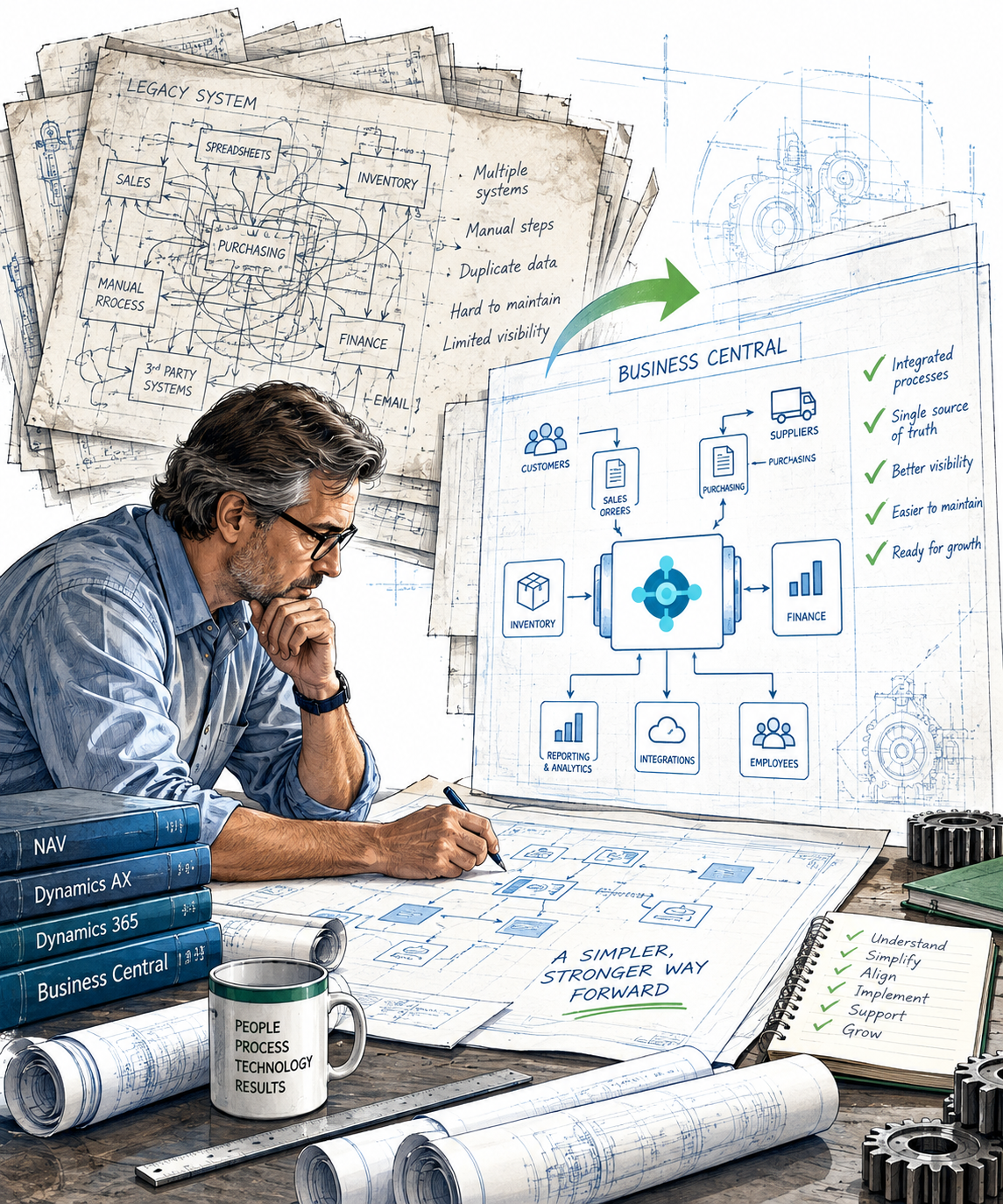
Approach based on decades of Dynamics experience
ERP projects often become complicated because technology starts driving the project instead of the business.
We try to do the opposite.
We look at how information moves through the organization:
- How orders are received
- How inventory is managed
- How purchasing decisions are made
- How employees complete their work
- How information reaches management
- How Business Central connects to other systems
Then we look for the simplest reliable way to support those processes.
Sometimes that means changing Business Central.
Sometimes it means changing the process.
Often it means doing a little of both.

REAL LIFE EXPERINCE – When Standard Business Central Wasn’t Enough
In one distribution environment, pricing was far more complex than a simple customer discount or item price.
Pricing depended on customer relationships, buying groups, product rules and other commercial conditions, resulting in millions of possible pricing combinations.
Standard Business Central functionality could not reasonably support the requirement, so a custom pricing solution was developed around the way the business actually sold.
We have taken the same approach with other requirements such as commissions, freight, purchasing and replenishment: use standard functionality where it fits, and customize where there is a clear operational reason.
Who We Work With
Z9Works primarily works with small and mid-sized organizations that need more from their ERP system but do not necessarily need the overhead of a large consulting firm.
Our clients commonly include:
- distributors and wholesale businesses
- companies running Microsoft Dynamics NAV (or even Navision) or Business Central
- organizations replacing older ERP or accounting systems
- businesses with complex purchasing, inventory or order-processing requirements
- companies that need Business Central connected to e-commerce, warehouse, reporting or external applications
- organizations looking for more responsive Business Central support
Many of the businesses we work with have already been using an ERP system for years.
They do not need someone to explain what an ERP is.
They need someone who can understand what is happening, identify the real problem and help fix it.
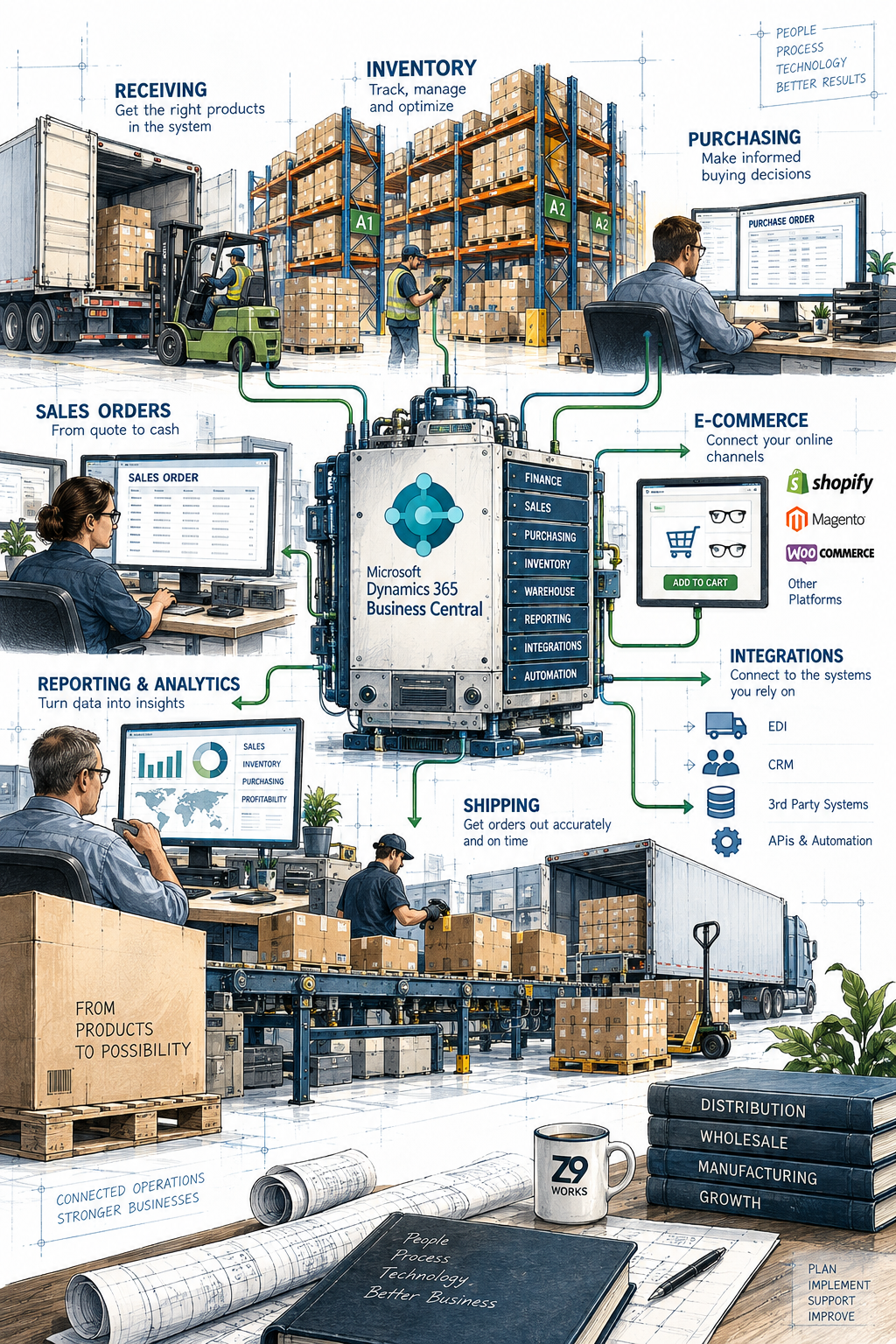
Experience Across Business Central and Dynamics NAV
Our work covers the full Business Central lifecycle, including:
Business Central Implementation
Planning, configuration, migration, development, testing and go-live support.
NAV/Navision to Business Central Upgrades
Moving organizations from older Microsoft Dynamics NAV environments to modern Business Central SaaS.
Development & Customization
AL development and extensions designed around specific business requirements.
Learn about GP to BC Migrations
Integrations
Connecting Business Central with websites, e-commerce platforms, warehouse systems, industry applications and other business software.
Reporting & Analytics
Business Central reporting, Power BI, Jet Reports and other tools that help turn ERP data into useful information.
Support & Troubleshooting
Ongoing support for users, system issues, performance problems and existing customizations.
REAL LIFE EXPERIENCE – A NAV Upgrade Is Rarely Just a Code Upgrade
We have worked with NAV and Navision environments containing years of custom development, external integrations, reporting databases and business processes that had gradually become dependent on the existing ERP.
In one environment, the system included more than 150,000 items, thousands of customer accounts, approximately 2,000 orders per day and several connected systems.
Moving that type of environment to Business Central SaaS is not simply a matter of converting NAV code to AL.
The real work is deciding which customizations are still necessary, which can be replaced by standard Business Central functionality, how integrations should be redesigned, and how to move the business without disrupting daily operations.
Even though that project took over 18 month, the result was the system that was simplified where it was reasonably possible, documented and justified, where customizations were required and delivered to the satisfaction of the client
A Small Team by Design
Z9Works operates with a focused team of experienced consultants and developers rather than a large organizational structure.
Our work is led from Ontario, with additional specialists across Canada, the United States and Europe.
This model gives us access to experienced Business Central resources while keeping communication direct and projects flexible.
For our clients, that means fewer layers between the business problem and the person solving it.

Technology Is Only Part of the Solution
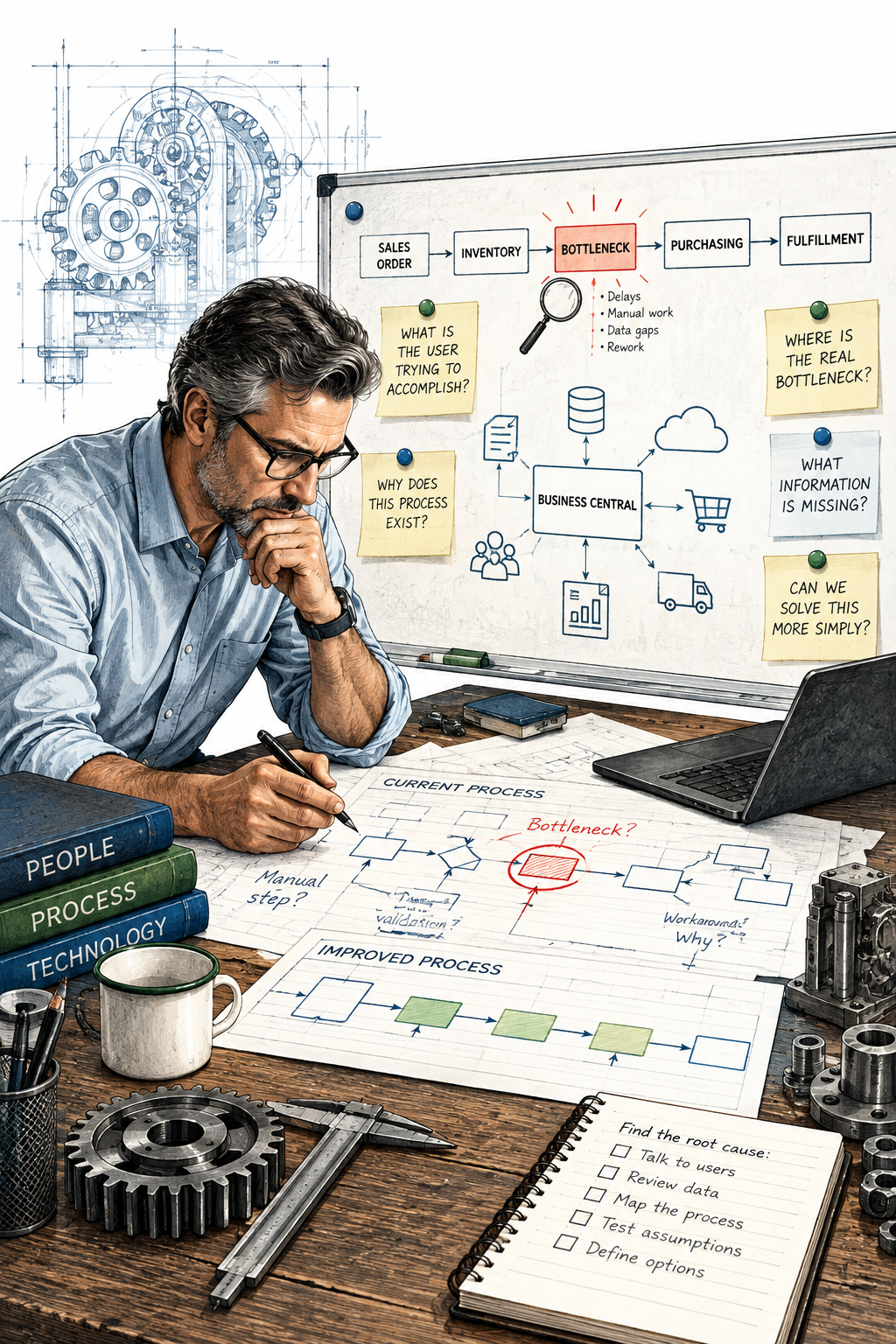
One of the most common mistakes in ERP projects is assuming that every problem is a software problem.
A poorly designed process does not automatically become a good process because it is moved into Business Central.
Before recommending development, we try to understand:
What is the user actually trying to accomplish?
Why does the current process exist?
Where is the bottleneck?
What information is missing?
Can the problem be solved more simply?
That mindset often leads to better solutions and less unnecessary complexity.
REAL LIFE EXPERIENCE – Working Inside Systems We Didn’t Build
A significant part of our work begins after a NAV (Navision)or Business Central system has already been in place for many years.
We have taken over environments where the ERP included custom pricing logic, multi-rep commissions, buying groups, freight calculations, replenishment tools, e-commerce integrations, reporting databases and industry-specific applications — often built or modified by different people over time.
In those situations, the first challenge is usually not development. It is understanding what is actually there.
We trace how the customizations interact, identify which processes the business still depends on, review where data moves between systems, and separate useful functionality from workarounds that have accumulated over the years.
That matters because replacing everything can be just as risky as leaving everything untouched.
Our approach is to preserve what still works, simplify what no longer makes sense, and make future changes easier to support.
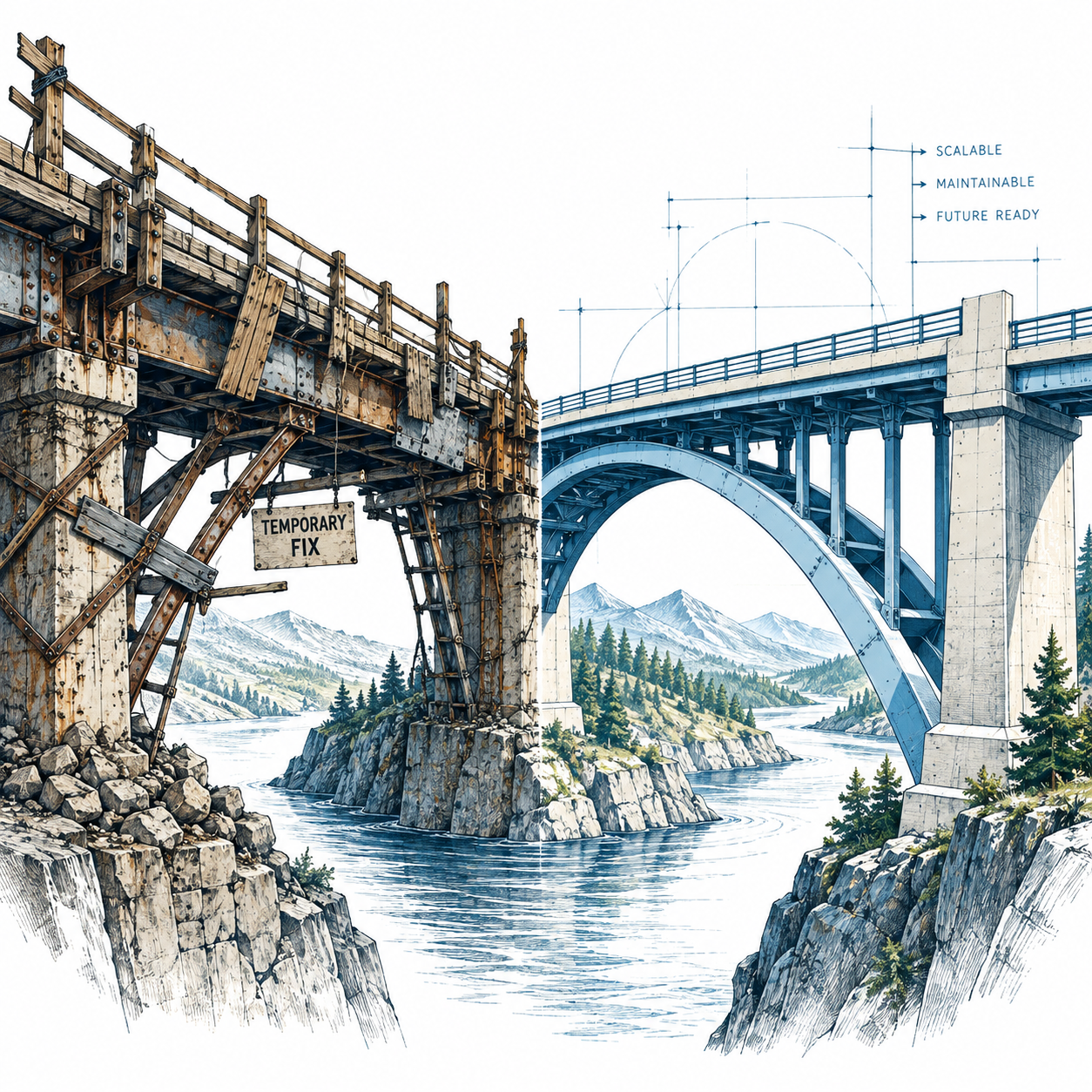
Long-Term Systems, Not Short-Term Fixes
Business Central systems tend to stay in place for many years.
A customization that looks convenient today can become expensive if it makes every future upgrade, integration or change more difficult.
We try to make decisions with that long-term reality in mind.
Our goal is not simply to make something work.
It is to build a solution that remains understandable, supportable and adaptable as the business changes.
REAL LIFE EXPERINCE
Built for the Next 12 Years, Not the Next 12 Months
A distributor/manufacturer running Microsoft Navision asked us to build a campaign reporting module.
The initial idea was a relatively quick solution that would solve the immediate reporting requirement. We recommended a more robust design because we could already see that the module would likely become part of a much larger business process.
The approach we proposed cost about 30% more than the short-term option. At the time, that was a meaningful difference.
But the module has now been running for roughly 12 years.
It has survived changes in the business, new reporting requirements and years of day-to-day use without needing to be replaced.
In hindsight, the additional investment was small compared with the cost of rebuilding the solution several times over.
Talk Directly With Someone Who Understands Business Central
You do not need to arrive with a detailed specification.
If something in Business Central is not working the way it should, your processes have become overly complicated, or you are unsure how to approach a project, start with the problem.
Tell us what is happening.
We can help you figure out what the next step should be.